
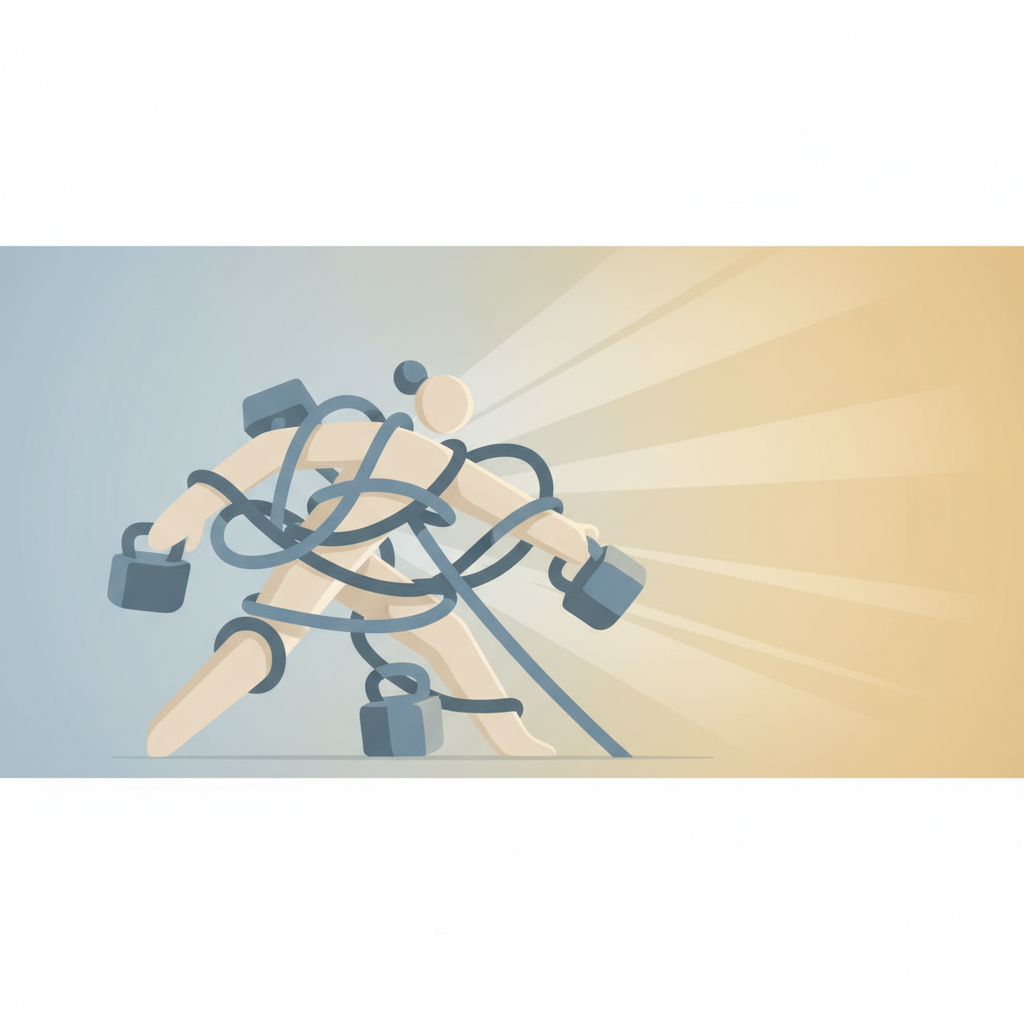
For months, if not years, I’ve had an idea for a blog. It wasn’t a vague notion, it was something I’d thought about properly, something I knew I wanted to do. And yet it sat there, in that familiar pile of things I’d get to “one day.” The friction was somewhere hard to name, living in the gap between having an idea and knowing how to turn it into something real, in the thinking and structuring and sense-making that has to happen before any content actually exists.
That’s where most ideas stall, I think. Not at the final step, but in the messy middle. The part where you’re trying to figure out what you actually want to say, how to organise it, where to start. It’s invisible work, but it’s heavy, and heavy enough that “one day” can stretch on indefinitely.
I recently completed the AI for Business bootcamp run by Technative, and I want to be honest about what I expected going in. I assumed it would be like many courses I’ve encountered before: surface-level, probably a sales pitch dressed up as training, something I’d extract a few useful bits from and move on. The reality was very different. It was comprehensive, practical, and built progressively in a way that meant you were developing foundational skills without fully realising it until you needed them. The later weeks ramped up significantly, and by that point you had, almost without noticing, acquired the capability to build something real.
Where AI Added Value
What surprised me most wasn’t what the course taught me about AI’s capabilities. If I’m completely honest, prior to the course I thought I had a pretty good grasp on what AI could do in theory, but I hadn’t necessarily seen it in practice. What the course taught me was more about where AI actually adds value in my own workflow, and in doing so it gave me the skills to recognise where it can add value in other people’s workflows too.
I came in with assumptions shaped by the usual noise: AI as a content production machine, something that generates documents, presentations, images, videos. And there’s truth in that, it can do those things. AI’s creative capabilities are fine, they have some utility, and generic content has its place. It just doesn’t quite hit the mark.
What I didn’t expect was that the final output, the actual creation of content, turned out to be almost the smallest step in the process. And it’s the step that benefits most from human touch, from voice and authenticity and the particular way you want to say something. What AI transformed for me wasn’t that final step. It was everything that came before it.
The thinking. The structuring. The synthesis of ideas into something coherent. The building of narrative before you’ve written a word. This is the work that used to create friction for me, the weight that kept things in the “one day” pile. And this is where AI, used as a thinking partner rather than a production tool, genuinely changed things.
The Messy Middle
I don’t mean that AI did the thinking for me. It’s more that it became a collaborator in the thinking process. A way to externalise ideas, pressure-test structure, explore angles I hadn’t considered. It’s like having a knowledgeable colleague available at any moment, one who can help you make sense of rough material and shape it into something you can actually work with. The thinking remains human-led, but AI supports and accelerates it in ways I hadn’t anticipated.
This blog exists now because of this shift. Not because AI wrote it, but because the friction that was stopping me from starting has largely dissolved. The course gave me the skills to use AI in this collaborative way, and that changed my relationship with the messy middle of any project. The gap between intention and execution got smaller.
There’s a broader point here that I’m still thinking through. I feel confident now that there’s no piece of foundational knowledge I can’t upskill on quickly. That’s not to say experience has no value, it absolutely does, applying knowledge in context, navigating the nuances that don’t appear in any textbook, that’s where experience matters. But the barrier of “I don’t know enough about this to even start” has lowered significantly. I can enter unfamiliar territory, build context rapidly, and have confident conversations with people about how they work and what they’re trying to achieve. That opens doors to problems I might previously have felt weren’t mine to approach.
This blog is one example of what that shift looks like in practice. A relevant example, I think, because it’s concrete and it’s mine. But it’s just one example. The real change is in how I approach problems more broadly, how I think about where AI fits in a workflow, and how I understand the relationship between human-led thinking and AI-supported process.
If you’re exploring where AI might fit in your own work, I’d be curious to hear what’s resonating and what isn’t. I’m still learning, still figuring out what works and what doesn’t in different contexts. But if this reflection is useful, or if you’d like to think through where AI might actually add value in your workflow, I’m always happy to have that conversation.